Make a donation
Gear up for your next adventure:
As an Amazon Associate, this site earns from qualifying purchases at no extra cost to you.
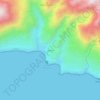
Atauro topographic map
Click on the map to display elevation.
Make a donation
Gear up for your next adventure:
As an Amazon Associate, this site earns from qualifying purchases at no extra cost to you.
Atauro
The landscape of the island is a result of the erosion of uplifted, originally submarine, volcanos from the Neogene period creating narrow, dissected ridges and steep slopes. Up to an elevation of about 600 m there are also extensive areas of uplifted coralline limestone. The climate is distinctly seasonal, with wet and dry seasons. The island has suffered from extensive clearing of its native vegetation for swidden agriculture. The upper levels of Mount Manucoco (above 700 m) still carry patches of tropical semi-evergreen mountain forest in sheltered valleys, covering about 40 km2. Lower down there are remnants of drier forest and Eucalyptus alba dominated savanna woodlands, especially on limestone outcrops, with agricultural land in the vicinity of villages. The island has a fringing reef 30–150 m in width; it generally lacks freshwater wetlands, estuaries and mangroves. In 2016 a Conservation International team found more species of reef fish per site in the waters surrounding the island than anywhere else in the world. Up to 315 species have been identified in single sites. The waters around Atauro suffer from marine plastic pollution, with waste coming from Dili and to a lesser extent Indonesia's Wetar island.
Make a donation
Gear up for your next adventure:
As an Amazon Associate, this site earns from qualifying purchases at no extra cost to you.
About this map

Name: Atauro topographic map, elevation, terrain.
Location: Atauro, East Timor (-8.30883 125.50112 -8.12690 125.64390)
Average elevation: 108 m
Minimum elevation: 0 m
Maximum elevation: 967 m
Make a donation
Gear up for your next adventure:
As an Amazon Associate, this site earns from qualifying purchases at no extra cost to you.
Other topographic maps
Click on a map to view its topography, its elevation and its terrain.
Dili
The main city lies within an area of flat lowlands of less than 100m altitude and a slope under 15 degrees. This distance between the sea and the mountains reaches a maximum width of only 4 kilometres (2.5 mi), and the surrounding mountains slope near the city at angles of 20 degrees or higher. The old quarter…
Average elevation: 337 m

Dili
The main city lies within an area of flat lowlands of less than 100m altitude and a slope under 15 degrees. This distance between the sea and the mountains reaches a maximum width of only 4 kilometres (2.5 mi), and the surrounding mountains slope near the city at angles of 20 degrees or higher. The old quarter…
Average elevation: 337 m

Make a donation
Gear up for your next adventure:
As an Amazon Associate, this site earns from qualifying purchases at no extra cost to you.

Same
The city is located in the interior of the island, 49 kilometres (30 mi) south of the provincial capital of Dili, at an altitude of 384 metres (1,260 ft), south of the mountain Cabalaki (Foho Kabulaki). The centre is located in the Suco Letefoho in which are situated the districts Ria-Lau (Rialau) Manico 1, 2…
Average elevation: 531 m

Make a donation
Gear up for your next adventure:
As an Amazon Associate, this site earns from qualifying purchases at no extra cost to you.


Make a donation
Gear up for your next adventure:
As an Amazon Associate, this site earns from qualifying purchases at no extra cost to you.


Gleno
Gleno has a tropical savanna climate (Köppen Aw), bordering on a tropical monsoon climate (Am), moderated by elevation. The dry season peaks in August and September, whilst the wet season extends from November to May with a peak from December to February. Gleno is substantially cooler and much wetter than…
Average elevation: 839 m
Make a donation
Gear up for your next adventure:
As an Amazon Associate, this site earns from qualifying purchases at no extra cost to you.


Make a donation
Gear up for your next adventure:
As an Amazon Associate, this site earns from qualifying purchases at no extra cost to you.


Make a donation
Gear up for your next adventure:
As an Amazon Associate, this site earns from qualifying purchases at no extra cost to you.


Make a donation
Gear up for your next adventure:
As an Amazon Associate, this site earns from qualifying purchases at no extra cost to you.

Jaco
East Timor > Lautém > Tutuala
The island is low-lying, with an area of 11 km2 (4.2 sq mi) and a maximum elevation of about 100 m (330 ft). It is covered mainly by tropical dry forest, fringed by strand vegetation and white sandy beaches. There are some low cliffs on the southern coast.
Average elevation: 23 m

Jaco
East Timor > Lautém > Tutuala
The island is low-lying, with an area of 11 km2 (4.2 sq mi) and a maximum elevation of about 100 m (330 ft). It is covered mainly by tropical dry forest, fringed by strand vegetation and sandy beaches. There are some low cliffs on the southern coast.
Average elevation: 17 m


Make a donation
Gear up for your next adventure:
As an Amazon Associate, this site earns from qualifying purchases at no extra cost to you.